

Budget 2026: Growth, Governance and the New Economic Momentum
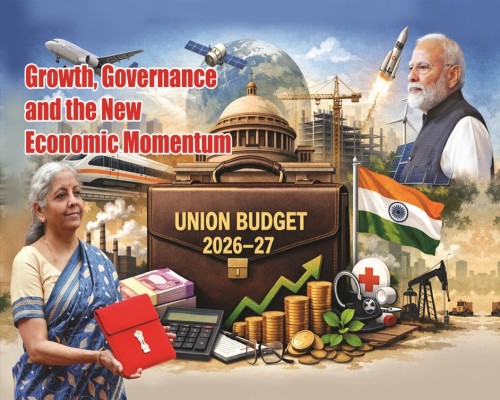
An in-depth analysis of how the Union Budget and Uttar Pradesh Budget together shape the future of industry, labour markets, MSMEs, infrastructure and regulatory compliance.
India’s fiscal story in 2026 is best read as a “two-budget” narrative: the Union Budget 2026–27 sets the macro frame—growth support without abandoning consolidation—while large states like Uttar Pradesh translate that frame into on-ground asset creation, welfare delivery, and administrative capacity. At the Centre, the most important anchor is the consolidation glide path: the fiscal deficit for Budget Estimates (BE) 2026–27 is pegged at 4.3% of GDP, with the Revised Estimate (RE) for 2025–26 held at 4.4% of GDP; simultaneously, the Centre signals a medium-term debt discipline by placing debt-to-GDP at 55.6% in BE 2026–27 (vs 56.1% in RE 2025–26).
Within that macro discipline, the Union Budget’s core economic bet is that India can “grow into” stability by keeping the public investment engine running while using targeted tax and compliance reforms to broaden formalization. The Union’s total expenditure in BE 2026–27 is estimated at ₹53,47,315 crore, with total capital expenditure at ₹12,21,821 crore and effective capital expenditure at ₹17,14,523 crore—numbers that clearly indicate the government’s preference for asset-creating outlays alongside support to states. Complementing this, independent budget analysis notes that capital expenditure is expected to rise by about 11.5% over the RE of 2025–26, reinforcing the “capex-led growth” approach that has become the defining macro stance of recent years.
A critical but often underappreciated element of the Union Budget 2026–27 is the scale of fiscal decentralization through transfers. The Union budget documents indicate that total resources being transferred to states—including state share in taxes, grants/loans and transfers under centrally sponsored schemes—are projected at ₹25,43,769 crore. This matters because it shapes the real spending power of states for roads, health, education, irrigation, urban infrastructure and local bodies, and it also gives political economy context to state budgets: the Union can consolidate while states maintain development momentum, provided inter-governmental transfers remain buoyant.
On the tax-and-compliance side, the Union Budget 2026–27 carries reforms that aim to simplify and reduce friction in the economy rather than rely only on higher spending. A headline reform is the stated rollout of the New Income Tax Act, 2025 from April 2026, signalling an attempt to modernize and rationalize the direct-tax framework (even as the year-to-year Finance Bill continues to carry rate and base changes). For corporates, the Budget makes a structural nudge toward the newer corporate tax regime by proposing to make MAT (Minimum Alternate Tax) the final tax, reducing the MAT rate to 14% from 15%, and restricting/set-limiting the use of brought-forward MAT credit in a way that incentivizes migration to the new regime (with no fresh credit accumulation from 1 April 2026).
Equally significant are the “everyday economy” measures embedded in customs/TCS rationalization and targeted exemptions, which are designed to lower costs and reduce compliance pain points for households and businesses. The tax reforms document associated with Budget 2026–27 highlights a reduction of TCS on overseas tour program packages to 2% (from higher prevailing rates) and a reduction of TCS to 2% for LRS remittances for education and medical purposes (from 5%), measures that directly affect middle-class outbound spending and education/health remittances. The same document highlights duty exemptions on select critical components (for example, some cost-intensive consumer electronics components) and exemptions for certain cancer drugs, along with expanding “duty-free personal imports” for medicines/food for additional rare diseases—steps that mix cost relief with a health-access intent.
Seen together, the Union Budget 2026–27 is not just about a single big-bang announcement; it is a portfolio of choices that balances (a) a visible capex push, (b) a credible fiscal deficit path, (c) predictable transfers to states, and (d) incremental but meaningful tax/compliance reforms. The macro credibility comes from the clearly stated deficit and debt ratios, while the growth impulse comes from the capex numbers and the continued emphasis on effective capital expenditure—particularly important because “effective” capex captures grants for capex and other channels through which public investment is executed beyond the Union’s own line ministries.
Uttar Pradesh’s Budget 2026–27 fits into this national frame, but with its own scale and priorities. The state has presented a ₹9,12,696.35 crore budget for FY 2026–27, which the state’s information department notes is about 12.9% higher than the previous year’s budget size. The state’s messaging places strong weight on fiscal sustainability: the UP budget speech indicates that the debt-to-GSDP ratio—already brought below 27%—is targeted to be reduced further to 23.1% in FY 2026–27, with a longer-term intent to push it even lower in a phased manner. In effect, UP is attempting the same “growth with consolidation” balancing act as the Centre, but expressed through sector allocations and project pipelines rather than only macro ratios.
Where UP’s budget becomes most tangible is in infrastructure and basic services, where allocations are large enough to change outcomes if execution stays strong. The state’s budget highlights document proposes ₹34,468 crore for construction, widening and maintenance of roads and bridges, including ₹4,808 crore for bridges, ₹1,700 crore for rail overbridges/underpasses, and large pools for state highways, district roads and road maintenance through the Rajya Sadak Nidhi. It also allocates ₹1,500 crore for bypasses, ring roads and city flyovers to ease urban mobility. This is a classic state-level translation of the national capex theme: logistics efficiency, urban decongestion and construction-led employment, with multiplier effects that complement Union priorities.
Public safety and administrative capability also stand out sharply in UP’s 2026–27 narrative. Media reports have described a record ~₹44,000 crore allocation for policing/internal security within the state budget’s overall ₹9.12 lakh crore envelope, framing it as a significant prioritization of law-and-order capacity. The state’s official highlights document, while not using that same headline number in the excerpted text, details concrete policing-related capital works: about ₹1,374 crore for non-residential police buildings, ₹1,243 crore for residential police buildings, ₹346 crore for police buildings in newly created districts, and additional allocations for fire stations and fire safety strengthening, plus Mission Shakti support for vehicles to enable women beat personnel mobility. For an economy the size of UP’s, improvements in predictability, safety and emergency response are not just governance outputs; they are investment climate inputs.
Health and human capital form the second major pillar of UP’s Budget 2026–27. The state proposes ₹37,956 crore for Medical, Health and Family Welfare, alongside ₹14,997 crore for medical education—and within that, additional specific provisions such as ₹1,023 crore for establishment/operation of 14 new medical colleges and ₹315 crore for the Cancer Institute, Lucknow. The document also references Ayushman Bharat and rural health mission channels, including provisions such as ₹8,641 crore for the National Rural Health Mission and ₹2,000 crore for Ayushman Bharat National Health Protection Mission, indicating a continued push to expand coverage while adding capacity. In practical terms, the state is attempting to move from “access” (insurance cards, facilities) to “capacity” (colleges, specialists, institutions) and “continuity” (public health programs).
Education and youth-focused public services receive similarly large allocations, suggesting an attempt to broaden the base of growth by improving learning conditions and skills. UP’s budget highlights propose ₹77,622 crore for Basic Education, including targeted provisions for uniforms/bags/shoes/stationery, model composite schools, residential girls’ schools where KGBVs are not present, and new “smart school” type initiatives. For Secondary Education, the budget proposes ₹22,167 crore (noted as 15% higher than 2025–26 in the highlights), along with allocations for school facilities and skill-linked clusters; for Higher Education, it proposes about ₹6,591 crore and includes a ₹400 crore provision for the Rani Lakshmi Bai Scooty Yojana for meritorious girl students. It also proposes a sharp increase in technical education allocations (about ₹2,365 crore, highlighted as a 72% jump in the state document), signalling a stronger skill-and-employability thrust.
Agriculture, rural development and local governance complete the UP budget’s development triangle—important because UP’s growth story is inseparable from rural incomes, farm-linked value chains, and the capacity of panchayats and local bodies to execute. The highlights document proposes about ₹10,888 crore for the agriculture sector (noted as 20% higher than 2025–26), and it references agri-export hubs and aquaculture infrastructure under externally aided and state-supported projects. It also proposes about ₹32,090 crore for Panchayati Raj schemes (stated as 67% higher), including ₹2,823 crore for Swachh Bharat Mission (Rural) Phase II and ₹454 crore for digital libraries at gram panchayat and ward levels—illustrating how “infrastructure” in UP is not only highways and bridges, but also sanitation, local public assets and service delivery modernization.
Taken as a combined cover story, Budget 2026–27 at the Union level and UP Budget 2026–27 at the state level show a policy alignment with distinct execution theatres. The Union sets the fiscal envelope (deficit at 4.3% of GDP, debt ratio directionally down), keeps capex large (₹12.21 lakh crore capex; ₹17.14 lakh crore effective capex), and pushes systemic reforms (direct-tax modernization timeline, MAT restructuring, TCS rationalization). UP, operating inside that national macro frame and supported by the broader architecture of transfers to states, lays out a high-volume, sector-spread plan: roads and bridges to unlock logistics, health and medical education to deepen human capability, schooling and skills to widen opportunity, and policing/fire services to strengthen the enabling environment for economic activity. The real test for both budgets is not the intent—clearly visible in the numbers—but the follow-through: timely releases, procurement discipline, outcome monitoring, and the ability to convert allocations into completed assets and improved services. If execution holds, Budget 2026–27 and UP Budget 2026–27 together map a coherent development logic: stabilize the macro, build assets, formalize the economy, and expand capability—so that growth becomes both faster and more broadly shareable.
Impact Analysis
The combined fiscal architecture of the Union Budget 2026–27 and Uttar Pradesh Budget 2026–27 carries deep structural implications for industry, labour markets, MSMEs, and regulatory compliance ecosystems. Beyond headline fiscal numbers and infrastructure allocations, the real impact lies in how capital formation, tax rationalization, sectoral incentives, and administrative strengthening reshape the operational environment for businesses.
1. Impact on Industry & Corporate Sector
1.1 Capital Expenditure Multiplier Effect
The Union’s ₹12.21 lakh crore capital expenditure allocation, along with UP’s heavy infrastructure outlays—particularly ₹34,468 crore for roads and bridges—directly stimulate:
- Construction and EPC companies
- Cement and steel industries
- Logistics & warehousing
- Real estate and industrial parks
- Power & infrastructure equipment manufacturers
Improved logistics corridors reduce freight costs, increase supply chain efficiency, and enhance export competitiveness—especially relevant for UP’s emerging industrial clusters (defence corridor, electronics manufacturing, food processing, textile parks).
1.2 Investment Climate & Law Enforcement
UP’s large allocation for policing and administrative infrastructure strengthens:
- Industrial security
- Contract enforcement environment
- Investor confidence
- Reduced disruption risks
For investors—both domestic and foreign—predictability of law and order is a fundamental economic variable. Strong policing infrastructure indirectly supports industrial growth.
2. Impact on Labour & Employment Ecosystem
2.1 Labour Formalization & Tax Reforms
The Union’s rationalization of corporate tax mechanisms (MAT restructuring) and direct tax simplification supports:
- Increased corporate migration to simplified tax regimes
- Reduced compliance friction
- Greater transparency in reporting
This improves labour formalization, since formal corporate taxation is directly linked to:
- EPFO & ESIC compliance
- Wage reporting transparency
- Social security enrollment
2.2 Capex-Driven Employment
Infrastructure expansion at both levels creates:
- Direct employment (construction, civil engineering, technical staff)
- Indirect employment (supply chains, transport, services)
- Skilled technical employment (medical colleges, education infrastructure)
UP’s expansion in medical education (₹14,997 crore) and technical education (₹2,365 crore) is especially significant for skill-based employment.
2.3 Human Capital Expansion
Heavy allocations to education and health expand long-term labour productivity. Better health infrastructure reduces absenteeism and improves workforce participation rates.
3. Impact on MSMEs
MSMEs form the backbone of UP’s industrial base and contribute significantly to national GDP.
3.1 Infrastructure & Market Access
Improved state highways, bridges, and urban bypasses reduce:
- Transportation delays
- Fuel costs
- Delivery timelines
- Supply chain uncertainty
For MSMEs operating on thin margins, logistics efficiency directly impacts profitability.
3.2 Credit & Compliance Stability
Macro fiscal stability at the Union level (4.3% fiscal deficit target) supports:
- Lower interest rate volatility
- Improved sovereign credit outlook
- Stable banking liquidity
This environment benefits MSME credit availability.
3.3 Rural Economy & MSMEs
UP’s large Panchayati Raj and agriculture allocations stimulate rural purchasing power, indirectly benefiting:
- Agro-processing MSMEs
- FMCG distributors
- Rural manufacturing clusters
- Micro-enterprises
Digital libraries and rural modernization projects enhance knowledge access and business literacy in semi-urban areas.
4. Compliance & Regulatory Impact
For compliance professionals, consultants, industrial HR managers, and labour law advisors, Budget 2026–27 has structural implications.
4.1 Tax Compliance Simplification
The proposed New Income Tax framework from April 2026 indicates:
- Transition planning for corporates
- Changes in payroll taxation structures
- Need for updated accounting & ERP systems
MAT reduction to 14% encourages migration to new corporate tax regime, which requires structured advisory support.
4.2 Increased Formalization Pressure
Higher public spending on infrastructure and social programs often increases:
- Regulatory inspections
- Environmental compliance scrutiny
- Labour code enforcement
- Digital reporting requirements
UP’s large-scale public investments may also strengthen enforcement agencies’ operational capacity.
4.3 ESG & Social Compliance
Heavy investments in:
- Health infrastructure
- Education
- Rural sanitation
- Police modernization
signal a governance push toward institutional strengthening. Corporates operating in UP must increasingly align with:
- ESG standards
- Social audit requirements
- Worker welfare frameworks
- PoSH compliance obligations
The compliance ecosystem will shift from reactive to preventive governance.