

Changing Global Climate Patterns Reshape Weather Across North India
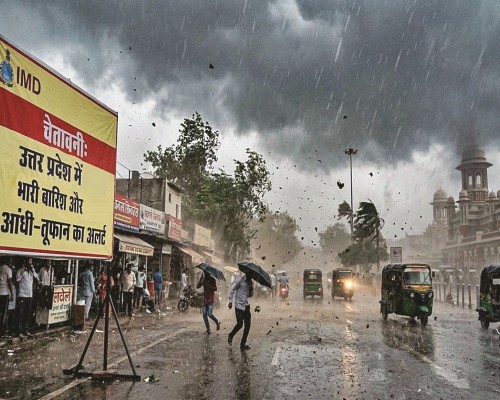
Unusual weather fluctuations across North India are increasingly being linked to broader global climatic shifts, with meteorologists pointing to a combination of atmospheric and oceanic factors that are altering seasonal patterns and creating prolonged instability in the region’s weather.
According to weather experts, March, which had initially begun with signs of a sharp rise in temperatures, soon witnessed an abrupt shift as rain, thunderstorms, gusty winds and a notable drop in temperature changed the overall weather pattern. This reversal has not only delayed the expected onset of intense heat but has also introduced a degree of unpredictability that could persist in the coming weeks.
Meteorologists are describing the current conditions as the result of a “multi-factor climate event,” where several large-scale natural systems are interacting simultaneously. Among the most significant contributors are active western disturbances, the influence of moisture from the Mediterranean region, changes in jet stream behavior, Arctic warming, and the broader effects of the La Niña phenomenon.
At the beginning of March, conditions had suggested that North India might experience an early and severe heat spell. However, within a short span, several parts of Delhi, Punjab, Haryana, Himachal Pradesh and large sections of western and northern India witnessed cloudy skies, rainfall and strong winds, bringing a temporary cooling effect and making the month feel more like an extension of winter than the beginning of summer.
Weather scientists note that one of the strongest immediate causes behind this shift has been the continuous arrival of western disturbances. These weather systems, arriving one after another over North India, have repeatedly triggered cloud formation and rainfall activity. As a result, the atmosphere has remained unstable, causing frequent and rapid changes in weather conditions.
Experts also believe that these regional disturbances are being amplified by global climate shifts. A key factor among them is the unusual southward movement of the jet stream. Under normal circumstances, the jet stream flows above the Himalayan region, but in the current scenario, its altered path has enabled western disturbances to travel deeper into the Indian subcontinent.
At the same time, increased moisture over the Mediterranean Sea is also affecting weather systems extending from Europe to Pakistan and India. This added moisture is helping sustain cloud formation and precipitation over North India, thereby reinforcing the cycle of unstable weather.
Another major concern being discussed by climate scientists is Arctic warming. The Arctic region is warming at a much faster pace than the rest of the world, a phenomenon widely referred to as “Arctic amplification.” This accelerated warming is disturbing the natural balance between cold and warm air masses across the globe, weakening long-established atmospheric systems and making weather behavior more erratic.
Scientists say this weakening of climatic equilibrium can directly affect the movement of weather systems, intensify seasonal disruptions, and create abnormal conditions in many parts of the world—including India. The result is a pattern where heat, cold, rainfall and wind no longer follow their traditional timelines or intensities.
The present weather over North India is therefore being seen not merely as an isolated event, but as part of a wider climatic transformation. Experts caution that such irregularities may continue to become more frequent in the years ahead, making weather forecasting more challenging and increasing the need for stronger climate adaptation measures.