
Technical Knowledge Must Complement Academic Degrees, Says Vice President Jagdeep Dhankhar
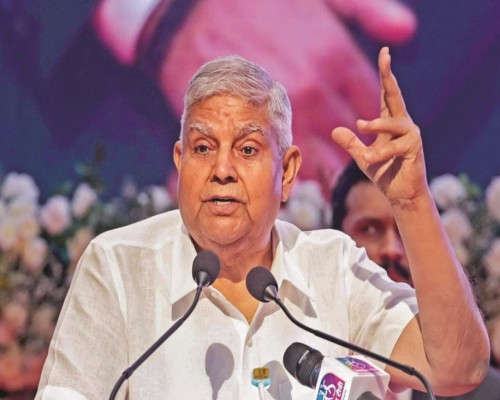
Emphasising the growing importance of skill-based education in a rapidly changing economy, Vice President Jagdeep Dhankhar said that academic degrees alone are no longer sufficient and must be complemented by practical and technical knowledge to prepare youth for the future.
He made these remarks while addressing the first convocation ceremony of Maharashtra State Skills University held at the Durbar Hall of Lok Bhavan in Mumbai, where he underlined the need to align education with employability, innovation and national development.
Speaking at the event, the Vice President said that in the present era, formal education must go hand in hand with hands-on technical capability. He stressed that those aspiring to become entrepreneurs or contribute meaningfully to the nation’s progress should not remain confined to theoretical learning alone.
According to him, true education should inspire not only professional growth but also a sense of social responsibility. He encouraged students to develop a mindset that combines competence with contribution, and career ambition with national commitment.
The Vice President noted that skill development is one of the strongest foundations of an Atmanirbhar Bharat, and said that India’s progress in the coming years will depend significantly on how effectively it equips its young population with market-relevant skills.
During the event, it was highlighted that the university has played an active role in promoting vocational and technical training among young people. According to the information shared at the programme, more than 25,000 youth have been awarded certificates through various training initiatives, while over 10,000 women have also been trained through the university’s skill-oriented programmes. These efforts have reportedly been carried out in collaboration with multiple international organisations as well.
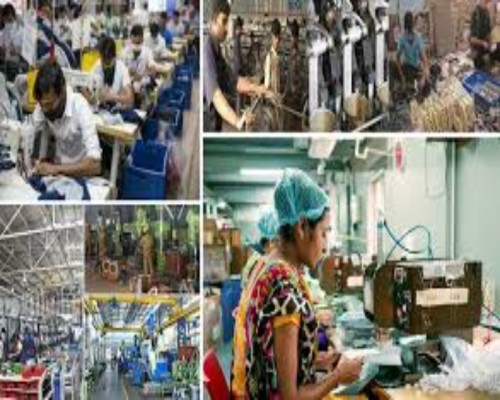
The ceremony also included references to the university’s broader mission of integrating education with employment opportunities and practical industry exposure. Speakers at the event stressed that skill-based institutions have a critical role to play in transforming India’s demographic strength into economic strength.
Maharashtra Governor C.P. Radhakrishnan, who was also present at the ceremony, stated that modern universities and administrators must remain connected to the real challenges and aspirations of students. He said educational institutions should not function in isolation from the evolving needs of industry and society.
Chief Minister Devendra Fadnavis also addressed the gathering and reportedly remarked that Maharashtra has taken a lead in modernising its approach to skill development, re-skilling and up-skilling. He said the state is working to create a stronger ecosystem in which universities can serve as engines of practical education and employment generation.
The event also reflected on the importance of integrating technical education with values of service and social contribution. Organisers and dignitaries highlighted that education should not merely produce degree-holders, but capable individuals who can contribute to both the economy and society.
In a parallel highlight of the event, the Vice President inaugurated an exhibition showcasing products and innovations developed by trainees and institutions working in the field of skill development. The exhibition included participation from women self-help groups and featured products such as handicrafts and handmade goods, reflecting the wider socio-economic impact of skill training.
The exhibition reportedly had 12 stalls, and gold medals were also awarded to meritorious students for their outstanding academic and training performance. Several industrial training institutions were recognised during the programme for their contributions to skill development and workforce preparation.
The convocation served as a broader message that India’s education system must increasingly move toward industry-linked, skill-driven and outcome-oriented learning, especially in a time when employability and innovation are becoming central to national competitiveness.
The remarks made at the event underscore a growing consensus in policy and education circles: in the modern economy, a degree may open the door, but technical knowledge, applied skills and adaptability are what sustain long-term success.