

Will Unplanned Development Continue to Consume India’s Forests?
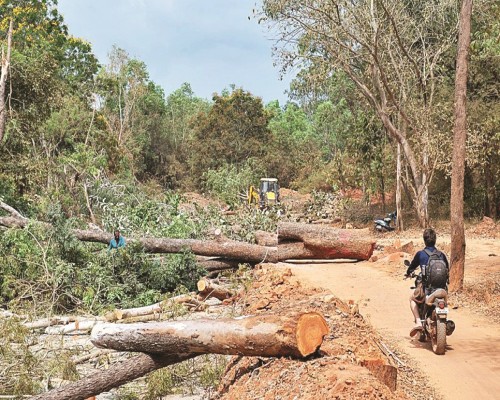
India’s pursuit of infrastructure development has brought roads, railways, industrial projects and urban expansion to the forefront of national growth. However, environmental experts are increasingly raising concerns that unchecked and poorly planned development is coming at the cost of the country’s forests, biodiversity and fragile ecosystems.
Environmental activist Suresh Bhai has highlighted the growing pressure on forested regions, citing a road-widening project in Uttarakhand’s Champawat district as an example of the conflict between development and environmental conservation. The project involves the expansion of a 54-kilometre stretch of the Tanakpur-Pithoragarh National Highway, a move that could significantly impact dense forest areas and rare wildlife species.
According to environmental assessments, the proposed widening could lead to the felling of more than 18,000 trees. The affected region is known for its rich biodiversity and serves as a habitat for several rare and endangered species, including the Himalayan black bear, leopard, deer, monkey, kakar (barking deer), and pheasant. Conservationists argue that such projects, if not carefully planned, may permanently alter the ecological balance of sensitive mountain ecosystems.
The concerns extend far beyond a single highway project. Data from the Forest Survey of India’s 2023 report indicate that approximately 29,000 hectares of forest land were diverted for non-forest activities during 2023-24, marking a significant increase compared to the previous year. Between 2014-15 and 2023-24, forest land has reportedly been allocated for a wide range of projects, including roads, district highways, mining, irrigation schemes, railways and power infrastructure.
Environmental experts point out that while official reports may show an overall increase in green cover due to plantations and agroforestry initiatives, such figures often fail to reflect the loss of natural forests. They argue that mature forests, developed over decades or centuries, cannot be replaced simply by planting new saplings elsewhere.
The ecological consequences of deforestation are profound. Forests play a critical role in regulating rainfall, conserving soil, maintaining groundwater recharge and preserving biodiversity. Research conducted in various mountain regions has demonstrated that dense forests support natural water systems by protecting springs, streams and rivers that serve nearby communities. The removal of trees often leads to soil erosion, increased vulnerability to landslides and a decline in water availability.
The Himalayan region presents a particularly sensitive case. Villages situated near forested slopes depend heavily on natural springs and streams for drinking water, agriculture and livestock. Environmentalists warn that large-scale tree felling and road construction in such areas could accelerate ecological degradation and increase the risk of natural disasters.
One example frequently cited by conservationists is the forest region near Champawat, where earlier proposals involving tree felling reportedly faced public opposition and legal scrutiny. Residents and environmental groups argued that the environmental costs outweighed the expected benefits and called for alternative solutions that would minimise ecological damage.
At the same time, local communities acknowledge the need for improved infrastructure. Better roads can enhance connectivity, facilitate tourism, improve access to healthcare and education, and contribute to economic development. However, many residents believe that development projects should be designed in a manner that balances human needs with environmental protection.
Experts advocate the adoption of environmentally sensitive planning methods, including route optimisation, reduced tree cutting, compensatory ecological measures and comprehensive environmental impact assessments. They argue that sustainable development should not be measured solely by the speed of infrastructure expansion but also by its ability to preserve natural resources for future generations.
The debate ultimately raises a larger question for policymakers: how can India continue to modernise while safeguarding its forests and ecological heritage? Environmentalists maintain that development and conservation need not be opposing goals. With careful planning, scientific assessment and community participation, infrastructure growth can coexist with environmental sustainability.
As India continues to invest in large-scale development projects, the challenge will be ensuring that economic progress does not come at the irreversible cost of the nation’s forests, biodiversity and natural ecosystems.