

Search and Seizure Powers Under Income Tax Law Upheld as Essential to Curb Tax Evasion
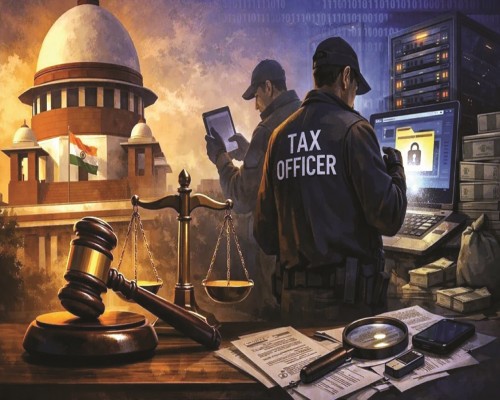
The Supreme Court has reaffirmed the importance of search and seizure provisions under the Income Tax Act, emphasizing that such powers are necessary to effectively tackle tax evasion, particularly in cases involving large-scale financial irregularities.
During the hearing of a public interest litigation challenging the constitutional validity of Section 132 of the Income Tax Act, the apex court declined to entertain the plea, thereby upholding the existing legal framework that grants authorities the power to conduct searches and seizures.
A bench comprising Chief Justice Sanjiv Khanna and Justice Sanjay Kumar observed that these provisions are designed to address serious instances of tax evasion and are not arbitrary in nature. The court noted that while such powers may appear stringent, they are essential tools for dealing with complex financial misconduct.
The petition had raised concerns that granting income tax officials the authority to carry out searches and seizures without prior disclosure of reasons could lead to misuse. It argued that such provisions may infringe upon individual rights and lack sufficient safeguards.
However, the bench dismissed these concerns, stating that the powers granted under the law are not unchecked and have been structured within a legal framework that ensures accountability. The court highlighted that the provisions have evolved over time and are subject to procedural safeguards.
Addressing the issue of prior notice, the court pointed out that in cases involving digital and financial evidence, advance warning could compromise investigations. It observed that if notice is given before a search or seizure operation, there is a high likelihood that crucial evidence may be destroyed, altered, or concealed.
The bench further remarked that digital records, which are increasingly central to financial investigations, can be easily manipulated or erased if suspects are alerted in advance. Therefore, maintaining the element of surprise is critical for the effectiveness of such enforcement actions.
The petitioner also contended that the absence of transparency in the exercise of these powers could lead to arbitrary actions. However, the court maintained that adequate legal remedies already exist for individuals to challenge any misuse or excesses by authorities.
Ultimately, the petitioner chose to withdraw the plea. The court permitted the withdrawal and allowed the petitioner the liberty to approach the central government for clarification or to seek amendments to the law, if necessary.