

Supreme Court Holds Lift Manufacturer, Maintenance Agency and Building Owner Jointly Liable for Elevator Accidents
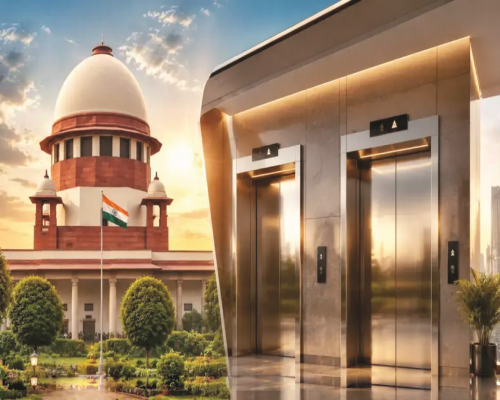
The Supreme Court has ruled that the manufacturer, maintenance operator and owner of premises housing an elevator can all be held jointly and severally liable when safety failures lead to an accident.
The Court emphasised that passenger safety is a fundamental obligation associated with every elevator and cannot be shifted entirely onto users. Comparing elevators to common carriers, the Bench observed that those responsible for their design, installation, maintenance and operation owe a high duty of care to passengers and must ensure that the equipment remains safe for use.
The ruling came while the Supreme Court upheld a decision of the National Consumer Disputes Redressal Commission in a case arising from a fatal lift accident at the headquarters of the Research and Analysis Wing in New Delhi in March 2003.
Fatal Accident Triggered Long Legal Battle
The case concerned former Indian diplomat Vipin Handa, who died after a serious elevator malfunction.
According to the case record, Handa and several other occupants were travelling in the lift after a meeting when the elevator stopped abruptly between the sixth and seventh floors. During rescue operations, Handa was reportedly positioned partly outside the lift when it suddenly descended, crushing him between the lift cabin and the floor.
Other occupants were rescued subsequently.
Following the accident, proceedings were initiated to determine responsibility for the failure of the elevator and the resulting death.
An FIR was also registered in connection with the incident, and an investigation was undertaken into the circumstances that caused the elevator to malfunction.
Consumer Commission Found Deficiencies
The deceased diplomat’s family approached the National Consumer Disputes Redressal Commission seeking compensation.
The Commission found deficiencies in the installation and maintenance of the lift and held the service providers responsible. It also examined the responsibilities of the building authorities and those entrusted with maintaining the elevator.
The Supreme Court, while considering an appeal against the consumer commission’s findings, declined to interfere with the conclusion that multiple parties could bear responsibility for the accident.
The Court affirmed the award of compensation of approximately ₹3.01 crore to Handa’s widow and two children, along with interest.
The compensation carried interest at 9 per cent per annum from March 20, 2003, with the rate rising to 12 per cent in the event of default beyond the stipulated period.
The consumer forum had apportioned liability among the parties, including 70 per cent on the elevator company, 25 per cent on the maintenance-related agency and 5 per cent on the building authority, according to the proceedings referred to in the judgment.
Safety Responsibility Cannot Be Fragmented
The Supreme Court laid down an important principle regarding elevator-related liability.
It said passengers normally have no control over the mechanical, technical or operational systems of an elevator. A person entering a lift is therefore entitled to assume that it has been properly designed, installed, inspected, maintained and operated.
For this reason, the burden of safety lies primarily on those who create, manage and maintain the system.
The Court observed that a manufacturer, operator and owner of premises cannot avoid responsibility by arguing that another entity was responsible for a particular component or stage of maintenance.
Instead, where their respective roles collectively contribute to the functioning of the elevator, they may be held jointly and severally liable for failures affecting passenger safety.
The Bench said the manufacturer, operator and owner together effectively act as custodians of the elevator from the perspective of public safety.
Passengers Need Not Determine Who Was at Fault
The judgment is significant because it reduces the burden on accident victims and their families in compensation claims.
The Court observed that consumers cannot reasonably be expected to investigate the internal division of responsibility between a manufacturer, maintenance contractor, building owner and other agencies before seeking compensation.
A passenger affected by an elevator accident should not have to determine whether the precise fault arose from defective manufacturing, improper maintenance, inadequate inspection or poor operation before pursuing relief.
Where negligence or deficiency has resulted in injury or death, the affected person or family may seek compensation from the entities responsible for ensuring the elevator’s safe functioning.
Those entities may subsequently determine their respective shares of liability among themselves.
Elevator Safety Described as a Fundamental Assurance
The Court highlighted the growing importance of elevators in modern urban infrastructure.
With increasing vertical development in residential, commercial and institutional buildings, elevators have become indispensable to everyday life. This dependence, the Court noted, makes proper safety standards even more critical.
The Bench stressed that every passenger entering a lift is entitled to a fundamental assurance that the equipment is safe and properly maintained.
Failure to provide that assurance can amount to a serious deficiency in service, particularly where known technical problems, inadequate servicing or improper safety procedures are involved.
Maintenance and Rescue Preparedness Under Scrutiny
The case also brought attention to deficiencies in the maintenance arrangements for the elevator involved in the accident.
The consumer forum had recorded concerns relating to repeated malfunctioning of the lift and the absence of adequate preventive measures despite earlier complaints.
Questions were also raised about maintenance records, emergency rescue arrangements and whether personnel had been properly trained to respond to lift failures.
The findings highlighted that elevator safety involves more than routine servicing. Building owners and maintenance agencies are also expected to maintain proper records, respond promptly to technical complaints, ensure availability of emergency procedures and implement recommendations arising from inspections.
Wider Implications for Building Owners and Service Providers
The Supreme Court’s decision has implications for commercial complexes, residential societies, offices, hospitals, hotels, factories and other establishments that operate elevators.
Building owners cannot assume that awarding an annual maintenance contract completely transfers their safety responsibilities to a service provider.
Similarly, maintenance agencies and manufacturers may remain accountable where defects, poor servicing or inadequate safety systems contribute to an accident.
The judgment therefore reinforces the need for coordinated responsibility among all stakeholders involved in elevator operations.
Regular inspection, preventive maintenance, proper documentation, trained rescue personnel and timely correction of identified defects are essential components of a compliant elevator safety system.
By recognising joint and several liability, the Supreme Court has strengthened the rights of consumers and accident victims while placing a clear responsibility on manufacturers, maintenance agencies and property owners to ensure that elevator safety is treated as a continuing obligation rather than a matter of contractual convenience.