
After Nitish Kumar’s Exit, Bihar’s Political Landscape Faces a Major Realignment
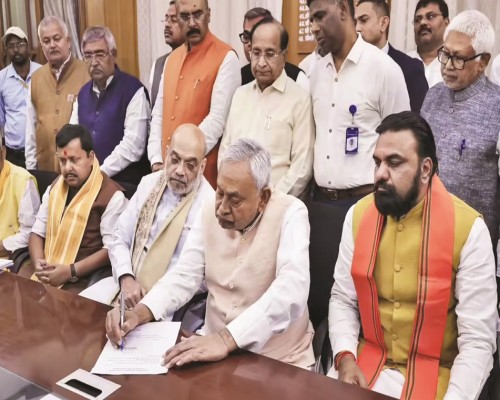
Bihar’s political landscape is undergoing a significant transition following the decision of long-time Chief Minister Nitish Kumar to move away from state leadership and transition toward national politics. For more than two decades, Nitish Kumar remained the central figure in Bihar’s governance and political alliances, often shaping the balance of power between competing parties. His exit from the state’s top executive position has created a new political environment in which the Bharatiya Janata Party (BJP), now the dominant partner in the ruling alliance, faces the challenge of establishing its own leadership and expanding its social support base.
Nitish Kumar served as Chief Minister of Bihar multiple times and maintained influence over the state’s politics for over twenty years. His leadership combined administrative reforms, coalition management, and social engineering strategies that brought together diverse caste and community groups. Because of his personal credibility and cross-caste appeal, he functioned as a stabilizing force within the alliance between his party, Janata Dal (United), and the BJP.
With Kumar stepping aside, Bihar enters a period of political uncertainty. Analysts believe the transition could reshape the ideological and electoral dynamics of the state. Under Nitish Kumar, politics in Bihar had long been rooted in the “Mandal” framework — a political structure emphasizing representation for Other Backward Classes (OBCs) and marginalized communities. The BJP’s attempt to lead the government more directly could shift the narrative toward a stronger ideological emphasis on Hindutva politics, although this transition is expected to face structural challenges.
The Challenge of Replacing a Dominant Political Figure
Nitish Kumar’s political stature in Bihar has few parallels. His governance model and personal reputation allowed him to maintain broad support across caste groups, regions, and communities. Even when his party did not hold the largest number of seats within the alliance, he remained the consensus choice for chief minister due to his credibility and administrative image.
The BJP now confronts the task of filling the political vacuum left by Kumar’s departure. Although the party has grown significantly in electoral strength in Bihar in recent years, it does not yet have a leader with the same cross-community appeal that Nitish Kumar cultivated over decades.
Political observers note that Kumar’s leadership helped sustain a delicate coalition of caste groups — including Extremely Backward Classes (EBCs), Kurmis, other OBC communities, and sections of upper-caste voters aligned with the BJP. Maintaining this coalition without his personal influence could prove difficult for the ruling alliance.
BJP’s Bid to Become the Dominant Force
For the BJP, the evolving political scenario represents both an opportunity and a risk. The party has long aspired to lead the government in Bihar with one of its own leaders as chief minister. Nitish Kumar’s departure could open the door for such a development, marking a historic shift in the power structure of the ruling coalition.
However, achieving this goal will require careful political balancing. Bihar’s electoral politics are deeply influenced by caste identities, regional loyalties, and social coalitions that have evolved over decades. Historically, the BJP has been perceived as having stronger support among upper-caste voters, while other parties such as the Rashtriya Janata Dal (RJD) and JD(U) built their base among backward and marginalized communities.
To consolidate its position, the BJP must therefore expand its outreach among backward classes and other key social groups that formed the backbone of Nitish Kumar’s support base.
Possible Reconfiguration of Bihar’s Political Contest
The changing political environment may also reshape the broader opposition dynamics in Bihar. If JD(U)’s electoral strength declines following Kumar’s exit, the state could witness a more direct political contest between the BJP and the opposition Rashtriya Janata Dal (RJD) led by Tejashwi Yadav.
Such a bipolar contest could fundamentally alter Bihar’s political equations, which have historically revolved around multi-party alliances and shifting coalitions.
At the same time, the internal transition within JD(U) could influence the stability of the ruling alliance. Maintaining party unity, preserving its traditional vote bank, and ensuring a smooth leadership transition will be crucial for JD(U)’s political future.
End of a Long Political Era
Nitish Kumar’s long tenure as Bihar’s chief minister made him one of the most enduring figures in Indian state politics. Since first assuming office in 2005, he oversaw multiple governments and navigated complex alliance shifts while retaining a central role in governance.
His departure from the chief minister’s post therefore marks the end of a significant era in Bihar’s political history. For supporters, he represented a model of governance associated with development and administrative reform. For critics, his frequent alliance changes illustrated the fluid and pragmatic nature of coalition politics in the state.
A Turning Point for Bihar Politics
As Bihar moves into this new phase, the political balance of power remains uncertain. The BJP’s ability to expand its social base, JD(U)’s success in sustaining its organizational strength, and the opposition’s strategy in mobilizing voters will all play decisive roles in shaping the state’s future political trajectory.
What is clear, however, is that the departure of a leader who dominated Bihar’s political landscape for over two decades has opened a new chapter in the state’s politics—one that could redefine alliances, leadership, and electoral strategies in the years ahead.