
Modi Government Marks 12 Years in Office as BJP Highlights Welfare and Development, Congress Counters on Jobs and Inflation
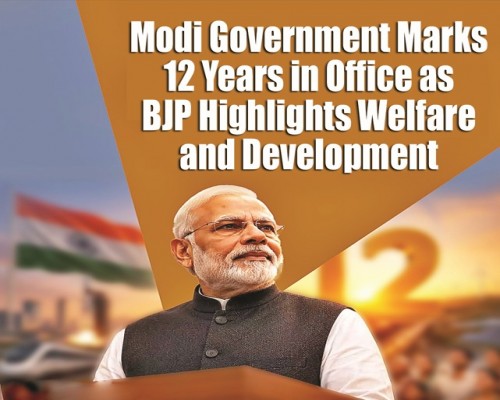
As the Narendra Modi-led government completed 12 years in office, the Bharatiya Janata Party presented the anniversary as a milestone of governance, welfare expansion and infrastructure-led transformation, while the Congress used the occasion to question the government’s record on unemployment, inflation and examination-related irregularities. The political moment gained added significance as Prime Minister Narendra Modi crossed the tenure of Jawaharlal Nehru to become India’s longest-serving elected Prime Minister in continuous office.
The BJP’s messaging around the completion of 12 years focused heavily on the argument that governance under Prime Minister Modi had made the lives of ordinary citizens simpler, more secure and more prosperous. Party leaders described the period as one in which welfare schemes, direct benefit transfers, digital systems and large-scale infrastructure projects combined to produce a visible change in everyday life.
According to the party’s narrative, the government’s biggest achievement lies in the way public delivery systems have been redesigned. It has argued that citizens who once struggled with layers of paperwork, middlemen and delayed benefits now receive support more directly through technology-enabled systems. Financial inclusion, welfare portability and the use of digital platforms have repeatedly been projected as key features of this transformation.
On the occasion of the government completing 12 years, Union Home Minister Amit Shah said the country had seen the simultaneous fulfilment of two major goals—poor welfare and unprecedented development. In a public message, he said that under Prime Minister Modi’s leadership, India had emerged as the world’s fastest-growing major economy and that a long list of welfare measures had changed the condition of millions of people.
Among the achievements highlighted by Shah were free ration for 80 crore people, pucca houses for more than four crore poor families, health insurance cover of up to Rs 5 lakh for nearly 50 crore people, and LPG connections for more than 10 crore families under social welfare schemes. He also referred to major advances in transport and connectivity, including the construction of 1.45 lakh kilometres of roads and around 3,000 kilometres of expressways.
The BJP also used the occasion to showcase the broader political message of continuity and decisiveness in leadership. Party functionaries said that the government’s 12-year journey had not only delivered schemes but had also changed the national mood. According to their argument, the India of 2014 was marked by uncertainty and pessimism, whereas the current moment reflects greater confidence, stronger infrastructure, improved welfare reach and a more assertive global profile.
The completion of 12 years in office also became symbolically important because Prime Minister Modi crossed the tenure of Jawaharlal Nehru as an elected Prime Minister. With 4,399 days in office, he moved ahead of Nehru’s 4,398 days in terms of continuous tenure as an elected Prime Minister. BJP leaders described this as a historic development and used it to underline what they called a new chapter in India’s democratic and political journey.
At a public event held to mark the occasion, BJP leaders listed a series of achievements that they said had directly affected daily life. These included welfare programmes such as Har Ghar Nal, household toilets, Ujjwala, and schemes aimed at farmers, youth and entrepreneurship, including Startup India and Mudra Yojana. The government’s supporters also pointed to growing digital penetration and public service delivery mechanisms as signs of an increasingly efficient state.
The larger claim advanced by the ruling party was that the last 12 years had brought “good governance leading to prosperity.” In this formulation, the success of the government is measured not only through macroeconomic claims but also through changes at the household level—availability of banking services, cooking fuel, housing, health protection, road access and welfare support. BJP leaders argued that these interventions have made governance more visible in people’s everyday lives.
One of the sectors repeatedly cited in support of this narrative was agriculture. The ruling side highlighted income support for farmers and the expansion of budgetary support to the sector. It pointed out that under the PM-Kisan scheme, eligible farmers receive annual financial assistance directly in their bank accounts. The party also claimed that the agriculture budget had increased sharply over the years, contrasting the allocation of 2013–14 with the much higher allocation for 2026–27.
The government’s supporters also pointed to digital transformation as one of the defining features of the last 12 years. The use of online systems, direct transfers and simplified service delivery mechanisms was described as an important reason why governance outcomes are now reaching people faster. The BJP’s broader political argument is that a combination of administrative reform, technology and welfare delivery has produced a structural improvement in the relationship between the state and the citizen.
At the same time, the anniversary was not politically uncontested. The Congress mounted a strong criticism of the government’s performance and accused the BJP of celebrating while ignoring deep economic and social problems. The opposition party said that behind publicity campaigns and promotional messaging lay a harsher reality of rising unemployment, inflation and institutional failure.
Congress leaders argued that the country’s economic and social indicators were not in line with the picture being presented by the ruling party. They alleged that the government had relied heavily on publicity and image-building while important concerns affecting ordinary people had continued to worsen. In particular, the Congress targeted the issues of paper leaks, high prices and employment stress.
According to the opposition’s criticism, multiple recruitment examinations had been affected by leaks and irregularities. Congress leaders claimed that over a ten-year period, 89 paper leak incidents had taken place and that 48 examinations had to be cancelled. They said such failures had deeply harmed the prospects of young people and weakened confidence in public recruitment systems.
The opposition also attacked the government over inflation, especially the rising cost of essentials. It cited the sharp increase in LPG cylinder prices and argued that the economic burden on families had grown despite the government’s claims of welfare expansion. In its attack, the Congress drew attention to the contrast between social welfare announcements and the continued pressure of price rise on household budgets.
This produced a familiar but politically significant contrast. While the BJP emphasised welfare saturation, direct transfers, roads, housing, health cover and the country’s global standing, the Congress focused on employment insecurity, rising living costs and governance failures in examinations and recruitment. The anniversary therefore became both a celebration for the ruling coalition and a political battlefield over competing narratives of India’s recent transformation.
Even within the BJP’s celebratory framing, the completion of 12 years was portrayed as part of a longer political and developmental journey rather than as a closing chapter. Party leaders indicated that the emphasis would continue to remain on large infrastructure, social support schemes, rural and urban connectivity, and a digitally enabled governance model. The underlying message was that the government sees itself as having moved from entitlement-based welfare to targeted, technology-backed service delivery.
The political importance of the moment also lies in how it may shape public debate in the months ahead. The ruling party is likely to continue foregrounding statistics related to welfare outreach, infrastructure creation, health coverage, housing and economic scale. The opposition, in turn, is likely to keep pressing on the gap between headline achievements and lived experience, especially in relation to employment, inflation and educational uncertainty.
Taken together, the three strands of the moment—the celebration of 12 years in office, the symbolic milestone of surpassing Nehru’s elected tenure, and the sharp exchange between the BJP and the Congress—capture the larger character of current national politics. For the ruling party, the period is proof of decisive leadership and transformative governance. For the opposition, it is a time to demand accountability for unresolved economic and institutional problems.
The anniversary therefore stands not merely as a political marker but as a moment of competing interpretations. One side describes the last 12 years as a period in which governance reached the poor more effectively and transformed public life. The other argues that despite welfare schemes and infrastructure expansion, serious distress remains visible in jobs, prices and opportunities. The debate over the meaning of these 12 years is likely to remain central to India’s political discourse for some time.