
On the road to Seemanchal: Castes split and solidify, but Nitish stands above
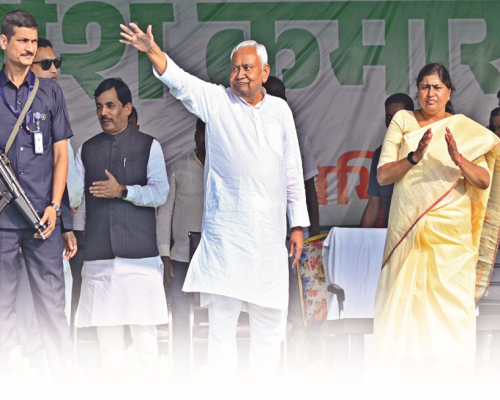
As one travels from Patna into Bihar’s north-eastern region of Seemanchal—passing through Sikandara, Jamui and Katihar—a clear political pattern emerges: castes that once clustered under broader categories are now operating as distinct electoral blocs, each with its own leader and agenda. Yet one political figure appears to transcend this fracturing terrain: Chief Minister Nitish Kumar, whose coalition of EBCs (economically backward castes) and other groups keeps him above the churn.
Caste realignments in Bihar
In Bihar politics, caste has long been central. But the nature of caste-politics is changing: many individual communities are no longer subsumed under a general “backward caste” umbrella; they now campaign and negotiate as specific units. Here, communities such as the Kushwahas, Mallahs and Manjhis exemplify the trend—distinct, organised, and increasingly autonomous.
Despite this fragmentation, Nitish Kumar—who himself started as a Kurmi leader—has built a broad coalition across multiple caste groups, not just his own Kurmi base. This gives him a deeper reach in comparative terms: the Kurmis are under 3 % of the state population, whereas rival blocs (for example, Muslims plus Yadavs) account for over 30 %. Yet his support among EBCs remains firm.
The EBC anchor
In places such as Barhbigha in the Jamui region, voters from Dhanuk, Paswan and Manjhi communities voiced loyalty to Nitish’s brand of governance. One Dhanuk voter put it simply: “He gave us roads, electricity and security—if we don’t vote for him, then whom will we vote for?” The message: development and stability matter, and the personal appeal of the leader still carries weight.
Nitish’s government has taken explicit steps to institutionalise support for EBCs: in 2006 a 20 % reservation was approved for EBCs in panchayat bodies; in 2010 an entrepreneurship scheme earmarked state assistance for EBC-owned businesses; the 2023 caste survey found EBCs to comprise about 36 % of the population in Bihar. Such policies reinforce the narrative of inclusive governance under Nitish’s leadership.
Trouble ahead? Fault-lines and fatigue
Even though support remains substantial, signs of fatigue are appearing in some communities. In Jamui, certain Kahars (Chandravanshi) question whether the backing for Nitish has delivered enough. One e-rickshaw owner from the Kahar community cited police action against BPSC job aspirants in Patna earlier this year as an instance of disillusionment. Meanwhile, the rival Rashtriya Janata Dal (RJD) could gain ground, drawing not just its traditional Yadav-Muslim base but also communities that feel neglected.
Another point of friction: in the Barhbigha constituency, an independent Bhumihar candidate—previously a sitting MLA from JD(U)—is running after being denied the party ticket. His candidacy threatens to split votes in unexpected ways, potentially aiding the opposition. In a clear illustration of how caste and local dynamics can upset assumptions, this instance shows that even leaders with strong statewide appeal must guard against micro-level shocks.
Why Nitish still stands above
What sets Nitish apart is his ability—over two decades in office—to transcend narrow caste identity and become a symbol of stability and governance for a wide range of backward and other castes. While others such as the RJD’s Tejashwi Yadav or the Bharatiya Janata Party’s Bhumihar/Kushwaha leaders are seen primarily as representing specific caste constituencies, Nitish’s reach extends beyond his Kurmi origins into a broader EBC coalition.
Moreover, his image—despite health issues and political weariness—is still robust in many rural pockets. He is seen not as one more politician, but as “Nitish Babu,” the man who delivered infrastructure and stability in otherwise neglected areas. That personal connect remains a vital part of his political survival.
The bottom-line
As Bihar heads into election season, the bipolar picture of traditional caste blocs is giving way to a more fragmented, fluid environment. Communities once aligned under large caste umbrellas are now organising themselves independently, making electoral arithmetic more complex. In that evolving landscape, Nitish Kumar’s advantage lies in his still-loyal EBC network and a reputation for delivery that cuts across caste lines. But the cracks are emerging: local fissures, independent candidacies, community disquiet—all could test the robustness of his coalition.
For now, though, on the road to Seemanchal and throughout Bihar’s backward belt, one thing remains clear: while the castes split and solidify, Nitish stands above them.